

After some research and advice from our taxi driver, we had a rough idea of what the tour should cost and knew there would be plenty of companies offering rides. Prices may have changed, but I definitely recommend asking your hotel or hostel what a reasonable price is before going.

The experience itself is exactly what it looks like: tourists floating through narrow waterways lined with coconut trees in round basket boats, wearing Vietnamese hats provided by the boat drivers.During the tour we watched a fishing demonstration and drifted through the quiet channels. For an extra fee, you can also have the boat driver spin the basket boat extremely fast in circles (which we knew we had to do).

In true Vietnamese fashion, our boat guide also acted as our personal photographer and took about a million pictures of us throughout the ride (another good reason to tip)!It’s definitely a bit of a tourist trap, but honestly, it was a really fun one.After the tour we grabbed a coconut drink before heading back to Hoi An’s city center.


We also sampled some dishes unique to Hoi An, including:
Bánh Bao Bánh Vạc (White Rose Dumplings)
Cao lầu, a local noodle dish with pork

After our coffee break we set out on a self-guided walking tour of Hoi An’s Old Town.Some highlights included:
Japanese Covered Bridge – a 16th-century bridge connecting the Japanese and Chinese quarters, with a small temple inside
Ba Mu Temple – a beautiful temple gate with a lily pond in front
Old House of Tan Ky – a historic home where the same family has lived for seven generations
Fujian Assembly Hall – an ornate Chinese-style building dating back to the 1750s


At night the town transforms with glowing lanterns hanging everywhere. You can walk through the night market or take one of the small wooden boats decorated with lanterns that float along the river. The rides cost around $4–10 for about 15–20 minutes, and sometimes include releasing a lantern into the water.

We decided to admire the boats from shore before eventually ending up at an outdoor bar several floors up. It wasn’t quite a rooftop, but close enough, and it was the perfect place to enjoy a cocktail while looking out over the glowing town!
Vietnamese Cooking Class
The next morning we decided to take a cooking class, which turned out to be one of the highlights of our time in Hoi An.We booked a private class through Viator for around $20 per person, which included hotel pickup and drop-off. The class was run by a local family at a beautiful home nearby.
All the ingredients were prepared for us, and we were guided through cooking four dishes ourselves:
Deep fried spring rolls
Papaya salad
Bánh xèo (Vietnamese pancakes)
Pho soup

There was a huge amount of food, and the entire experience was relaxed, fun, and incredibly delicious. After lunch they drove us back to our hostel where we packed up and headed back to Da Nang – this time to the train station.


There was also a food cart and dinner service on the train, which was honestly better than expected. We left the station just after 6 PM and woke up the next morning rolling into Ninh Binh just before 9 AM.


Where I Stayed
We stayed at Hang Mua Eco Garden Homestay, a family-run property surrounded by lotus ponds, greenery, and dramatic limestone mountains. The family who owned the homestay were incredibly welcoming, kind, had great recommendations, and spoke little to no English.


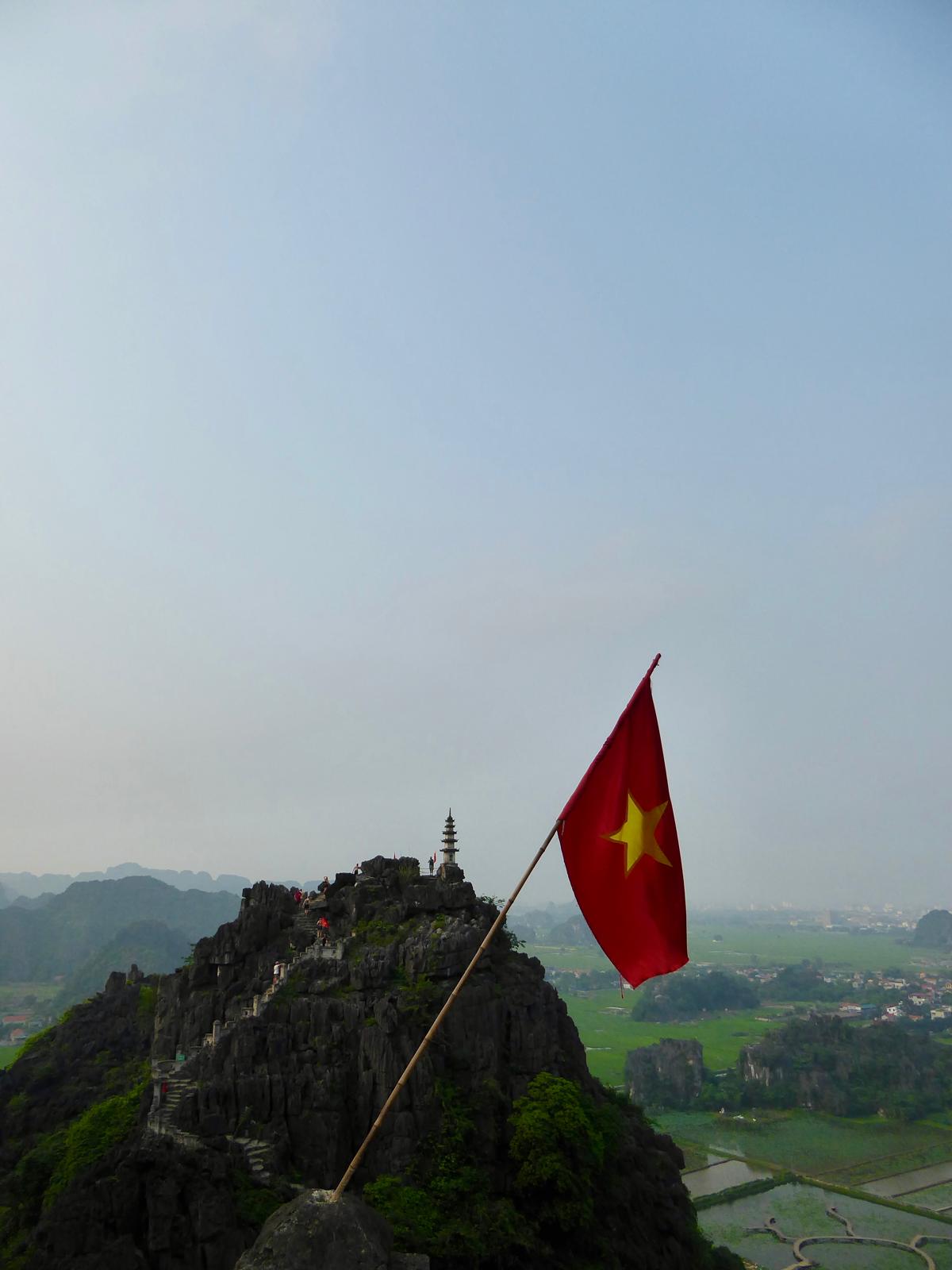
You cross a small stone bridge to reach the entrance, then pass through caves and climb several staircases to reach higher temples with amazing views. Along the way there are sculptures, bells, and shrines tucked into the mountainside. Further past the complex is Xuyen Thuy Cave, where a singular man has a boat business touring people through the cave where you can see stalactites and an insane amount of bats hanging from the ceiling.


But the reward at the top is incredible: sweeping views over the Tam Coc valley and the winding Ngo Dong River. The dragon statue at the summit also makes for some very cool photos if you’re patient enough to wait your turn.

Hoa Lu Old Town
On our final evening we visited Hoa Lu Old Town, about a 15–20 minute drive from the main area.If you’re short on time I would prioritize Ninh Binh’s natural attractions instead, but it was still a fun place to walk around at night. The bridges were lit up with colorful lights and traditional buildings lined the river.

We sat by the water at a pricey place for a drink, but wandered somewhere quieter in search of food. We were lucky to stumble upon an unassuming place filled with local families. The waiter spoke excellent English and was kind enough to recommend food to us, and we enjoyed a delicious meal.

Final Morning in Ninh Binh
Our final morning in Ninh Binh was one of the hottest days I experienced anywhere in Southeast Asia.We borrowed the bikes again and rode to a scenic café for coffee and banh mi.

As the midday heat peaked, we stopped at a small outdoor museum with straw tipi-like structures showing how traditional communities in the area were built.

It wasn’t something I’d go out of my way to visit, but it made for a nice stop during a very hot bike ride.
Eventually we returned to the homestay, said goodbye to our hosts, and took a taxi to the bus station.

Next stop: Ha Long Bay.
Choosing a Cruise
We booked a one-night, all-inclusive cruise through Halong Bay Cruise Hunters for about $150 per person. This included meals, activities, and transportation to our next stop. There are multiple night options available as well.There are tons of cruise options in Ha Long Bay, ranging from budget to luxury, but we were happy with the one we chose.
After boarding mid-morning, we checked in, received welcome drinks, and had lunch while the ship began sailing toward Lan Ha Bay, one of the quieter parts of the region.

Island Stop
Later we stopped at a nearby island where we could swim and explore. The island was beautiful, but extremely crowded.
This is something to keep in mind with Ha Long Bay cruises – most boats follow very similar itineraries, so popular stops can get busy, especially on weekends.

Kayaking Through the Limestone Karsts
The ship itself was fairly small and intimate, which was nice because it didn’t feel overcrowded. We quickly befriended a few other travelers on board.Our first activity was kayaking through the bay, which ended up being my favorite part of the entire experience. Paddling through the calm water surrounded by towering limestone cliffs felt surreal and was exactly the kind of scenery I had imagined when thinking about Ha Long Bay.

Back on board we enjoyed incredible views as the sun set over the limestone formations.The crew hosted a happy hour and a Vietnamese cooking demonstration, which was a fun way to spend the early evening before dinner.
The ship and crew were wonderful throughout the trip, and after dinner the night turned into a fun karaoke session with our shipmates!


After breakfast we stopped at a nearby cave for a short hike and exploration before returning to the boat.
Soon after, we checked out of our rooms, had one last meal on board, and the cruise transferred us to our next destination: Hanoi.
Note: Ha Long Bay is undeniably beautiful and seeing the limestone cliffs rising out of the water is something I’m glad I experienced. That said, the cruise experience felt very structured and tourist-heavy, since most boats follow nearly identical itineraries and stop at the same places. If you have enough time in your Vietnam itinerary, it may be worth seeing at least once. But if you’re short on time, I would personally prioritize places like Ninh Binh or Hoi An, which felt more relaxed and authentic to me.
Stop 5: Hanoi (3–4 Days)
Where I Stayed

Trấn Quốc Pagoda
We started our first morning at Trấn Quốc Pagoda, the oldest pagoda in Hanoi, originally built in the 6th century.The temple sits on a small island just off the edge of West Lake, connected by a narrow walkway lined with flags. The bright red pagoda tower rising above the water is one of the most recognizable sights in Hanoi. The complex itself is peaceful, with incense drifting through the air, bonsai trees, and several small shrines and statues throughout the grounds.

Imperial Citadel of Thăng Long
From there we headed toward the Imperial Citadel of Thăng Long, a massive historic complex that served as the political center of Vietnam for more than a thousand years. The citadel was first established in the 11th century during the Lý Dynasty and later expanded by multiple ruling dynasties. Today it’s a UNESCO World Heritage site, and you can walk through large open courtyards, ancient gates, archaeological excavation areas, and preserved palace foundations.

Hanoi Old Quarter
We spent most of the rest of the day exploring the Hanoi Old Quarter, wandering through its busy streets filled with bikes, markets, and endless food stalls.For lunch we had some of the most delicious bún chả at Bún Chả Đắc Kim, a long-standing spot known for its grilled pork served with rice noodles, herbs, and a flavorful dipping broth.

Old quarter highlights include:
Thê Húc Bridge – The iconic bright red bridge connecting the lake’s edge to Ngọc Sơn Temple.
Ngọc Sơn Temple – A small temple on an island in Hoàn Kiếm Lake dedicated to historical Vietnamese figures.
St. Joseph’s Cathedral – A striking Gothic cathedral built during the French colonial period.
Ho Chi Minh Mausoleum – The final resting place of Ho Chi Minh and one of the most significant political landmarks in Vietnam.


But truly the best part was simply strolling through the Old Quarter, exploring street stalls, people-watching, dodging the endless stream of motorcycles, stopping for coffee breaks, and watching the wonderfully chaotic city unfold around you.


Vietnam Museum of Ethnology
The next day, we visited the Vietnam Museum of Ethnology, one of the most fascinating museums in the city. The museum focuses on the 54 ethnic groups that make up Vietnam, highlighting their cultures, traditions, clothing, tools, and daily life.

Inside, there are detailed exhibits explaining the histories and customs of different communities across the country. One of the most interesting parts of the museum, though, is outside. The large outdoor area features full-scale traditional houses and buildings from different ethnic groups, including towering communal houses and stilt homes that you can actually walk inside.
Temple of Literature
Later we visited the Temple of Literature which was built in 1070 and was originally dedicated to Confucius. It later became Vietnam’s first national university, where scholars studied Confucian teachings and prepared for imperial examinations.

Train Street
In the evening, we made our way to the famous Train Street in Hanoi. It’s a narrow residential street where trains pass just inches away from people’s doorsteps, and residents have adapted to this unusual setup with cafes, small shops, and seating areas lining the tracks. I recommend confirming the train times before heading so you can time it right (be aware that vendors may say the train is coming soon to encourage you to sit and order at their establishment).

Grab a coffee or a beer and simply admire the setup until the train comes rolling through!

Hỏa Lò Prison
We had one more full-ish day in Hanoi. We started with breakfast at a cafe along Tây Hồ Lake where we were staying, which was lovely, and then headed to the Hỏa Lò Prison, also known as the “Hanoi Hilton.”

The prison has a sobering history, originally used by the French colonists for political prisoners and later during the Vietnam War to hold American POWs. Walking through the exhibits, you can see preserved cells, historical photographs, and artifacts that tell the stories of those who were imprisoned there. Hanoi has such a complex history, and I definitely recommend this museum for a glimpse into its past.
Stop 6: Ha Giang (3 Days)
Where I Stayed
For our last leg of Vietnam, we booked a 3-day, 2-night Ha Giang Loop tour through Jasmine Tours. The Ha Giang Loop is a scenic motorbike route through northern Vietnam’s mountainous region, and honestly, it’s one of the top experiences I’ve ever had. We stayed in a hostel the first night and various guest houses/ hostels along the way.

Getting There
We took a VIP overnight bus from Hanoi to Ha Giang, arriving early the next morning (around 3 a.m.) for our adventure. The bus was surprisingly comfortable, with each person having their own bed, blanket, outlet, and privacy curtain.

The Loop
For the loop, we opted to have drivers, which I strongly recommend unless you’re a SEASONED motorcycle driver. The winding, narrow, and occasionally muddy roads are not for the inexperienced. After a few hours of shuteye at our hostel, we got briefed and divided into groups of around 10, sized for helmets, and introduced to our drivers (AKA our lifelines for the next few days). My rider was about 19 years old but had grown up in the area and was just as comfortable tearing down mountain roads on a motorbike as he was walking. He told me he was working hard to save money for his and his girlfriend’s wedding; two years later, he’s now married with his first child!

Our bags were strapped to the back of the bikes (we stored heavier luggage at the homebase in Ha Giang and brought only what we needed for the 3-day trip), and then we were off! The sensation of flying down steep mountains, wind in your hair, with breathtaking views all around, is hard to beat. We passed through villages, stopped along the way to stretch and take in the scenery, and cracked open a beer or two.

Words hardly do it justice.
After several hours on the bikes, we reached our stop for the night, where we enjoyed dinner, “happy water” that magically erased any soreness, and endless karaoke.

Day 2
The second day began with a stop in front of a stunning backdrop, where local ladies braided tourists’ hair with flowers, an excellent solution for helmet hair. We continued riding and made a stop at a point where you can see China across the border. I was so close to China that I even got a text from my phone plan welcoming me to the country!

Along the way, we saw farmers tending to their land and lots of animals, as well as local kids walking along the streets, playing, or helping their parents. It was amazing to witness this vastly different way of life and to see people farming on such steep mountainsides.

We also stopped at Nho Que River Valley, a winding river surrounded by towering limestone peaks, and even took a boat tour to enjoy the scenery from a completely different perspective. Another highlight was Ma Pi Leng Pass, or the “High Pass,” an iconic viewpoint overlooking the river gorge. It makes for incredible photos (if you can brave the terrifyingly high overlook)!

Day 3
The last day was our ride back down the mountains, soaking in the last views of the terraced rice fields and breathing in the fresh mountain air. We said farewell to our drivers, tipped them generously, and made our way back to Hanoi the same way we came. And from Hanoi, we headed straight to the airport!
2 weeks in Vietnam flew by and left me wanting more (not to worry, I returned with my dad 5 months later, but more on that soon). Such an incredible country filled with beautiful sights, friendly people, and delicious food.
Leave a Reply